Finding Hidden Gems: A Data-Driven Scouting Report for the Sacramento Kings
Introduction
This project originated as a mock assignment from a mentor simulating real-world NBA analytics work: the Sacramento Kings analytics staff needed recommendations for international players currently playing outside the NBA. The task provided mock JSON data on players who competed in both the NBA and major European leagues (EuroLeague, EuroCup, Spain’s ACB, and Italy’s Liga A), with the goal of demonstrating data ingestion, cleaning, exploratory data analysis, and communication skills.
However, I saw an opportunity to expand this into a comprehensive data acquisition project for my portfolio. Rather than relying solely on the provided mock data, I decided to incorporate real NBA statistics by web scraping Basketball-Reference.com. This allowed me to ground the analysis in actual team performance data and demonstrate end-to-end data science skills—from scraping and cleaning to analysis and visualization.
The Sacramento Kings haven’t made the NBA playoffs since 2006—the longest active drought in professional sports. While the franchise has struggled with draft decisions and roster construction, one potential avenue for improvement lies in international scouting. International players offer tremendous value: they’re often overlooked, cost-effective, and can fill specific roster gaps that traditional college prospects might not address.
By combining real 2020-21 Kings performance data with mock international player statistics, this project demonstrates how data science can enhance basketball operations. Using web scraping, data cleaning, and exploratory analysis, I built a scouting report that identifies which international prospects best fit the Kings’ specific roster needs.
The Question
Can we use data to identify international prospects who specifically address the Sacramento Kings’ weaknesses?
Rather than simply finding the “best” players, I wanted to create a weighted fit score that matches prospects to the Kings’ actual gaps in rebounding, playmaking, shooting efficiency, and overall impact.
Ethical Data Collection
Before diving into the technical work, I ensured my data collection followed best practices:
- Basketball-Reference.com’s robots.txt: I checked the site’s scraping policies and confirmed that accessing team statistics pages is permitted
- Respectful scraping: I implemented delays between requests and used Selenium only when necessary (not for bulk operations)
- Mock data for prospects: My mentor provided anonymized international player statistics to simulate a real scouting database without privacy concerns
- Public information only: All NBA data scraped is publicly available team-level statistics
The Web Scraping Challenge
Getting NBA data sounds straightforward—until you actually try it. Here’s what I learned.
Why Selenium Was Necessary
I initially attempted to scrape the 2020-21 Sacramento Kings page using Python’s requests library and BeautifulSoup. This worked for basic tables like “Per Game Stats,” but Advanced Stats—the metrics I needed most—were completely missing.
The problem? JavaScript lazy-loading.
Basketball-Reference doesn’t load all tables in the initial HTML response. Instead, JavaScript runs after the page renders in a browser, dynamically injecting critical tables like Advanced Stats, Shooting Stats, and Play-by-Play data. When you use requests.get(), you only receive the initial HTML—before JavaScript executes. The table wrappers exist (like <div id="all_advanced">), but they’re empty.
The solution? Selenium with Chrome WebDriver.
By launching a real browser, Selenium: - Executes JavaScript just like a human visitor would - Waits for DOM updates using WebDriverWait - Captures the fully rendered HTML via driver.page_source - Guarantees all 12 tables are present and parseable
# Example Selenium code to scrape Basketball-Reference team page
from selenium import webdriver
from selenium.webdriver.common.by import By
from selenium.webdriver.support.ui import WebDriverWait
from selenium.webdriver.support import expected_conditions as EC
from bs4 import BeautifulSoup

# Launch Chrome and load page
driver = webdriver.Chrome()
driver.get('https://www.basketball-reference.com/teams/SAC/2021.html')

# Wait for Advanced Stats table to load
WebDriverWait(driver, 10).until(
    EC.presence_of_element_located((By.ID, "all_advanced"))
)

# Parse fully rendered HTML
soup = BeautifulSoup(driver.page_source, 'html.parser')Trade-off: Selenium is slower (~3-5 seconds per page) but achieves 100% accuracy. For this project, reliability mattered more than speed.
Data Collection Steps
If you want to replicate this project, here’s your roadmap:
- Set up your environment
- Install Selenium:
pip install selenium - Download ChromeDriver matching your Chrome version
- Install BeautifulSoup:
pip install beautifulsoup4
- Install Selenium:
- Scrape team data
- Target URLs: Team pages (e.g.,
/teams/SAC/2021.html) and league overview (/leagues/NBA_2021.html) - Use Selenium for JavaScript-heavy pages
- Extract tables using BeautifulSoup’s
find_all('table')
- Target URLs: Team pages (e.g.,
- Clean and merge data
- Handle missing values using median imputation by season
- Calculate per-game statistics from counting stats
- Compute advanced metrics like True Shooting % (TS%)
- Prepare your prospect database
- Filter for players under 25 years old
- Require minimum 10 games played per season
- Aggregate multi-season data into career averages
Building the Fit Score
This is where the project gets interesting. Instead of ranking players by raw talent, I created a Kings-specific fit score based on their 2020-21 weaknesses.
Step 1: Identify Kings Weaknesses
I compared the Kings to the league’s top 5 teams across 11 key metrics: - Scoring (points per game) - Playmaking (assists per game)
- Rebounding (total rebounds per game) - Overall impact (Box Plus/Minus) - Efficiency (True Shooting %) - Ball security (turnovers—lower is better)
Step 2: Assign Priority Weights
Not all weaknesses matter equally. I assigned weights based on urgency: - Box Plus/Minus (20%): Overall impact is king - Rebounding (18%): The Kings were brutal on the boards - Assists (15%): Desperately needed playmaking - Turnovers (penalty): Lower turnovers = higher score
Weights sum to 1.0 for transparency and tunability.
Step 3: Calculate Fit Scores
For each international prospect:
Fit Score = Σ (Player's stat × Kings need weight)High scores indicate players who directly fill Sacramento’s biggest holes—not just “good” players, but the right players.
Key Findings
The Sacramento Kings Were Below Average
Comparing the Kings to the league’s top 5 teams revealed significant gaps:
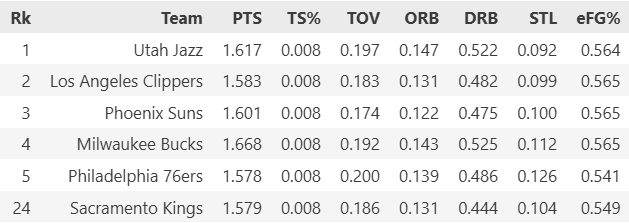
The bar chart below visualizes where Sacramento struggled most:
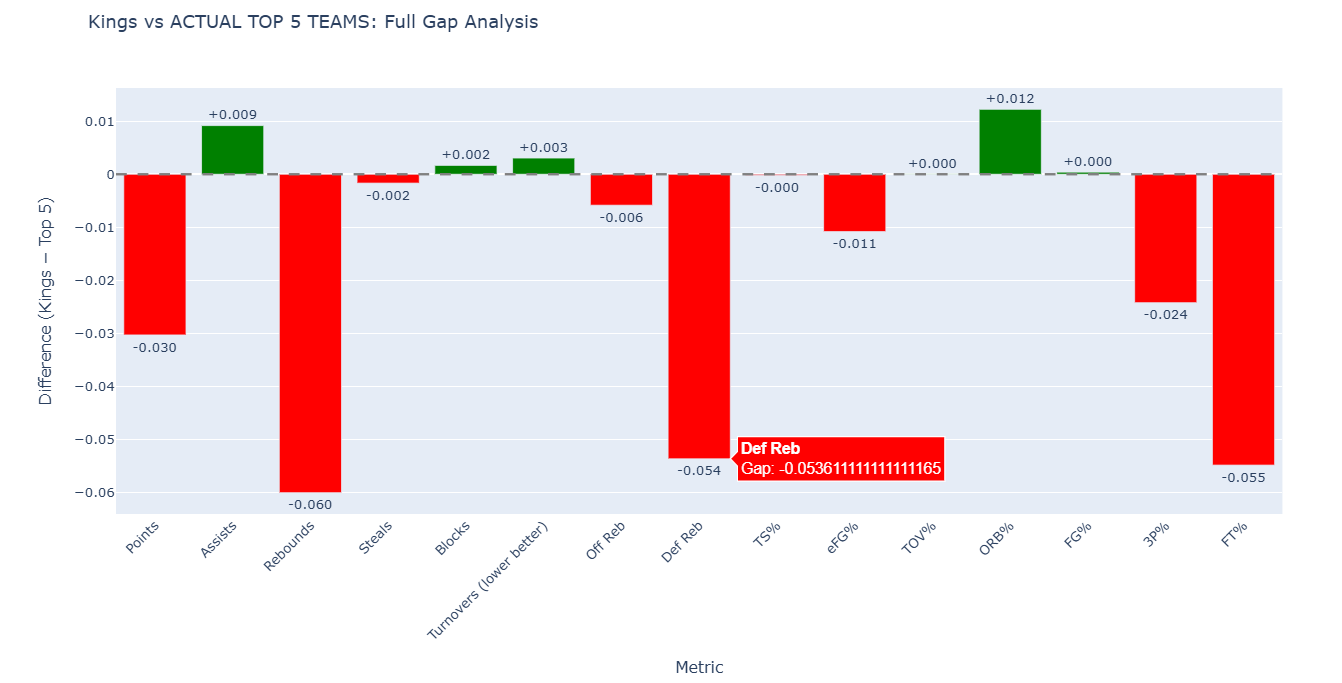 Rebounding and free throw percentage were critical weaknesses
Top 10 International Prospects
After running my fit score algorithm, these prospects emerged as the best matches for the Kings:
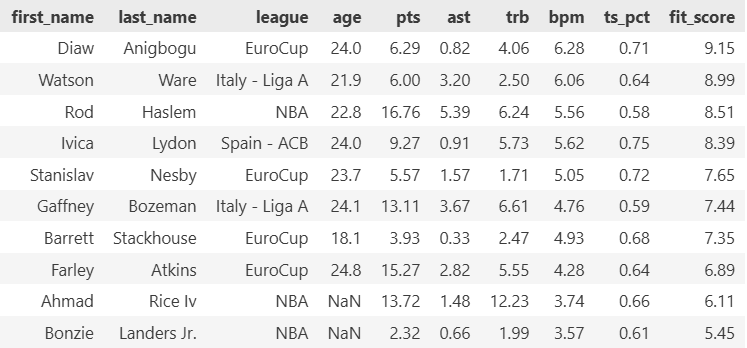 Ranked by fit score—how well they address Kings weaknesses
Prospect Skill Profiles
The heatmap reveals each prospect’s strengths:
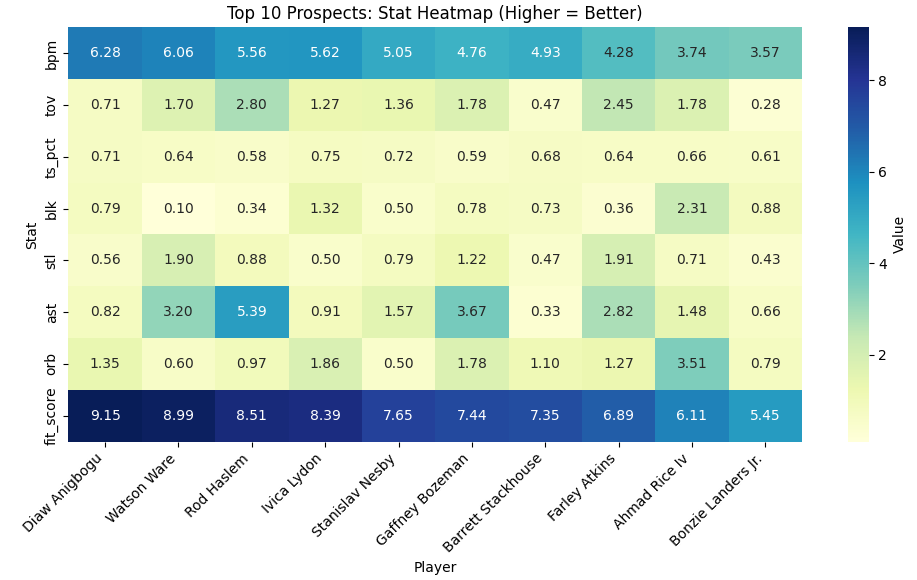 Darker colors indicate stronger performance in each category
Head-to-Head Comparison
How do these prospects stack up against the 2020-21 Kings roster?
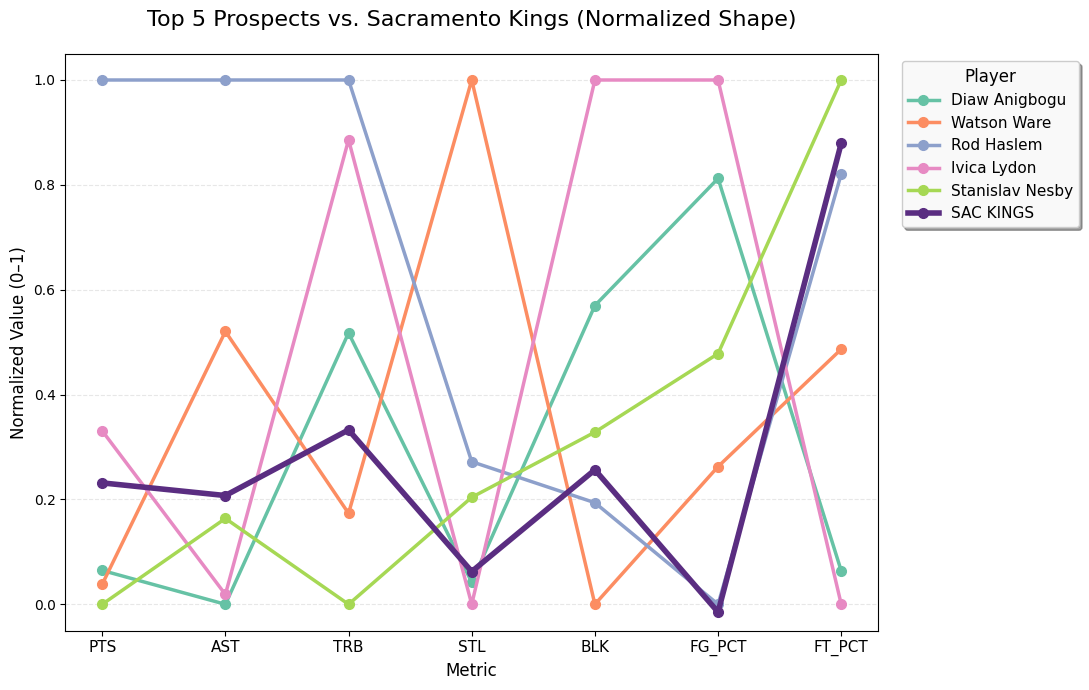 Normalized comparison shows where prospects exceed Kings averages
The top prospects consistently outperformed Sacramento in rebounding, defensive impact (BPM), and shooting efficiency—exactly what the team needed.
Technical Challenges and Solutions
Challenge #1: JavaScript-loaded content
Solution: Switched from requests to Selenium
Challenge #2: Inconsistent data formats across seasons
Solution: Median imputation by season context
Challenge #3: Avoiding division-by-zero errors in league comparisons
Solution: Built fit scores using absolute values and weights instead of ratios
Challenge #4: Handling missing Box Plus/Minus data
Solution: Used player-level averages for Kings; neutral 0.0 for league baseline
Reflections and Future Improvements
After completing this project, I identified a key methodological improvement for future iterations. Instead of comparing the Kings to league-wide averages, I should have scraped per-game and advanced statistics from each of the top 5 team rosters individually.
This roster-level approach would have allowed me to:
- Pinpoint specific positional weaknesses by comparing the Kings’ roster construction to elite teams
- Identify role-specific gaps rather than broad team averages
- Create more granular fit scores that match prospects to exact roster holes
- Account for lineup compositions and how individual players complement each other
By analyzing the actual rosters of championship-contending teams, the fit score algorithm would rely on where the Kings were truly weak relative to what makes teams successful—not just abstract league averages. This would produce more actionable scouting recommendations tied to proven winning formulas.
Conclusion
This project demonstrates how data science can enhance basketball scouting beyond traditional “eye test” evaluations. By combining web scraping, statistical analysis, and domain knowledge, I identified international prospects who specifically address the Sacramento Kings’ weaknesses—something generic “best available player” rankings can’t do.
The methodology is transferable: change the team, adjust the weights, update the season, and you have a new scouting report. That’s the power of reproducible data science.
Resources and Links
- Full code repository: GitHub - Kings Scouting Report
- Basketball-Reference: Team Stats / League Stats
- Selenium Documentation: Getting Started
- BeautifulSoup Tutorial: Web Scraping Guide